- Don't have Cable: This actually is a good time-saver too because hours wasted watching television, because there is limited television to begin with.
- Don't go out to movies: With Red Box or Netflix instant downloads, we only need to wait a couple months and watch a movie for $1-$2 as a couple instead of $20.

- Make my own tea: Instead of picking up a cup of tea at Starbucks for $2 a pop, I buy the 25-pack of the same tea for $3.
- Use online bill pay: The money comes out and pays the bills on the same day: pay day. This prevents over drafting funds and the bank charges that go along with that.
- Use cash: While cash can burn a hole in your pocket, using ONLY cash does prevent over-drafting the bank account and the charges that go with that. A couple months of using cash squashed any itch to spend the cash in my pocket because I knew that there was nothing left when that was gone. Plus, the change at the end of the day goes in the piggy bank!
- Bring a sack lunch. Lunch on the run can mean spending $3-$10 if I am careful, and even if I only have a few meals out during the week, that is $20-$40 a week.
- Unplug: Unplugging lamps, appliances, and electronics even when they were turned off brought our electric bill down by 15%.
- Make a list: Before I go shopping for groceries, clothes, or anything. Then, I stick to the list. If I need one pair of jeans, then I write that down and it helps me not pick up a couple shirts and some cute sandals because they aren't on the list.
- Don't buy bottled water: We love our Brita water filter, so we just fill our pitcher from the tap. Then, we use reusable water bottles and refill them as needed.
- Skip the salon: pedicures, massages, waxing, haircuts...they all add up fast! I have opted for the Great Clips around the corner for hair cuts and save the pedicures for the summer months, but I'm going to try to do my own toenails this year.
Showing posts with label money. Show all posts
Showing posts with label money. Show all posts
Sunday, February 13, 2011
10 Ways I save money


Sunday, February 6, 2011
Go Big or Go Home?
My husband and I love our home that is so often described of as "cozy," "cute," or a "cottage." It's our 1000 square feet tucked in a quiet neighborhood in the middle of Tucson. It definitely allows us the discipline of limiting our acquiring of "stuff" because, frankly, there is no room. It is quiet, relaxed, and right next to a great walking, running, cycling path on the mighty Rillito River (or as in Arizona, we know rivers as a big dusty ditch).
And then there is the option to buy a bigger house, over double the size of our house, smack dab in the middle of the Foothills, becoming more available to ministry. Needs a lot of updating, but it is geographically central to the direct ministry that I do, which means that there is a high likelihood that Ashley and I will never be in want of company.
So what's a girl to do?
Go BIG or go home?
Go BIG or go home?
Friday, February 5, 2010
Food for Though
These are some quotes I ran across this week that I enjoyed:
"There are two ways to get enough. One is to continue to accumulate more and more. The other is to desire less." G.K. Chesterton
"Everything we own owns us. It takes time to use it, dust it, paint it, maintain it, build space in a house for it, and work to pay for it." Richard Swanson
"My joy comes from clothing myself with the unfading beauty of a gentle and quiet spirit. It is joy because it is so precious to God." Cynthia Heald
Enjoy!
Monday, January 11, 2010
I Want to Ride My Bicycle
 My first purchase of the new year was an old Huffy beach cruiser, complete with a basket on the front, for $65 off of Craig's list.
I had read on one of my favorite blogs, Zen Habits, that one of the reasons that as a whole, the Japanese are healthier than Americans is because they walk or ride a bike everywhere. While I am not going to ride my bike everywhere, I thought, What is close enough to me that I could ride a bike to? And what came to mind is the grocery store and gas station around the corner, which is located on a strip mall that has all sorts of other stores also. We are constantly making those trips around the corner for the ingredient we forgot or what we are "all out of," or renting a movie from the DVD kiosk at the gas station for $1.49 (this is one of our favorite habits).
What if instead of doing those quick trips around the corner in my car, I rode a bike?
I could save on gas and emissions, be green, and put some more activity in my life. Sounds good. And so I searched for a low-cost bike, so that if this plan turns out like most New Year's resolutions, at least I'm not out too much cash.
I also picked up a pink bike helmet for about $15 and a matching pink bike lock for about $13. All in all, a $93 investment. My goal was to spend less than $100 on the whole ordeal.
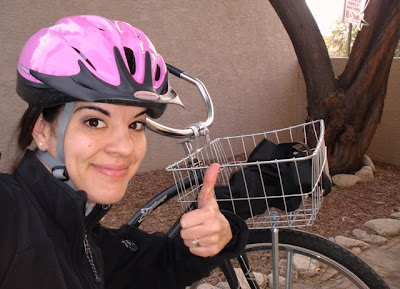.JPG) And yes, I did take my bike for it's maiden voyage to the grocery store, on a beautiful Sunday afternoon, and I learned a few things:
And yes, I did take my bike for it's maiden voyage to the grocery store, on a beautiful Sunday afternoon, and I learned a few things:- People think it's cute when a child rides their bike to the grocery store, and a little weird when an adult does.
- People don't want to make eye contact with a grown woman riding a bike with a basket wearing a pink bike helmet.
- The only adult that made eye contact with me and smiled was an old hippie, wearing a poncho, who was also riding his bike.
- Cars definitely saw me and gave me the right away--I also attribute that to the pink bike helmet.
- It takes me about the same time to ride my bike to the grocery store as it takes to drive (because of traffic lights and parking).
- It takes about 2 blocks before my thighs start burning.
- Helmet hair is not as bad as I thought.
I have to say that I also enjoyed hearing the sounds of the outdoor world instead of my radio yelling commercials at me. My cell phone rang, but I couldn't answer it because I am not talented enough to talk and ride at the same time, and I enjoyed the time to myself not on the phone. I also got to reward myself with an extra cookie without any guilt.
My conclusion is that it was totally worth it and I will do it again!
Wednesday, September 23, 2009
When to Ebay, Craig's list, or Buffalo
Ahhh...the classic dilemma: How do I sell my stuff? It's a great way to make a few extra bucks while ridding my life of the excess and clutter that is around me. But, when do you use what resale service? Here's my quick guide to when to use what service:
1. Ebay
1. Ebay
- This is where you make the most money.
- Items that are like new or slightly used.
- Items from brand names and stores that are sought after.
- When you have 1-5 items to get rid of.
- Useful if you have the time to sell each; about 30min-1hour for each item to set up, sell, and mail.
- Average $2-$5 per item (maybe up to $10 for bigger items).
- It seems like these stores have a mental block from taking everything, they may take 10%-60% of your items, so you have to come with a lot.
- Good for if you have at least 2 large bags full.
- Items can be from new to more used than items you would put on Ebay.
- Brand names, styles from within the last year, or great vintage pieces.
- Most helpful if you can block out a morning or afternoon and hit all the stores that buy used clothing with the same bags.
- Craig's list is great if you just want someone to come and take your stuff more than you want to make a couple bucks.
- Don't expect to make money, maybe $2-5 for a bag of clothes.
- Price items based on what you would expect to pay at a garage sale, because that is what Craig's list is, a giant garage sale.
- Items can be in any condition.
- Should't take a lot of time or energy--it's more like a creative dump.
- One word of advice: never meet someone alone, bring a buddy.
Friday, August 7, 2009
The Vacation Account
 Ashley and I are fans of INGDirect, and online bank, which usually has higher interest earnings than a traditional bank (though in the recent economy has caused the interest to take a hit). One of the reasons we like ING is because it takes about a week for withdrawn funds from ING to arrive in your traditional bank, so you really have to plan your finances.
The best thing is that you can open multiple savings accounts and label them for what you want the money to go toward. Thus, the vacation account!
Everyone has their priorities, and travel is one of ours, so we opened a vacation savings account that Ashley and I both deposit into monthly, about $100-$200 a month.
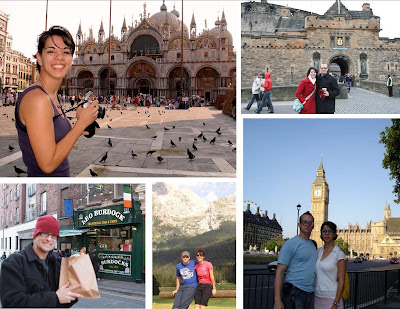
People ask us all the time how we can travel around the world. Ashley and I always say that everyone has their priorities that they choose to spend money on. We like to travel. Consequently, we don't go out to eat in nice restaurants, we don't see movies (outside the cheap theater), we don't have nice clothes or nice cars, etc.
In the end, Ashley and I decided that travel is an important enough part of our life that we have a savings account that we set aside money in so that we can travel without stressing about how to pay for our adventures. One of the best financial decisions we have made.
Wednesday, August 5, 2009
I heart Dave Ramsey
In the pursuit to simplify, my husband and I have been taking a look at our personal finances to figure out how to simplify our financial life. Really, it is a pursuit of financial health. One of my friends introduced me to Dave Ramsey and his financial wisdom, and we just love him. It is more of a biblical financial plan than a budget.
I agree with Dave Ramsey's ideas and principles about how to handle finances because it means having specific goals for your money and designating money for certain purposes. The idea is that if your money is already designated, you are less likely to spend it.
Dave Ramsey has seven baby steps to financial freedom, and sadly to say, I'm only on step two:
I agree with Dave Ramsey's ideas and principles about how to handle finances because it means having specific goals for your money and designating money for certain purposes. The idea is that if your money is already designated, you are less likely to spend it.
Dave Ramsey has seven baby steps to financial freedom, and sadly to say, I'm only on step two:
- $1,000 to start an Emergency Fund
- Pay off all debt
- 3 to 6 months of expenses in savings
- Invest 15% of household income into Roth IRAs and pre-tax retirement
- College funding for children
- Pay off home early
- Build wealth and give! Invest in mutual funds and real estate
But is has totally changed how my husband and I look at our personal budget.
Wednesday, February 11, 2009
Cha-Ching with Change
I realized pretty quickly that when I started working in all cash (instead of cards), that I ended up with a lot of change by the end of the day. 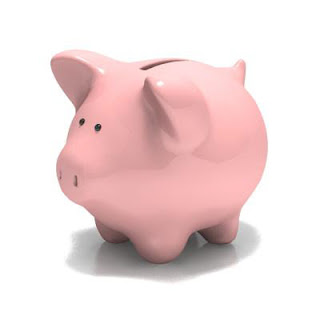
Time to bring back the piggy bank! At the end of every day, I empty the wallet, pockets, and car consul and throw all the change in a tin.
I consider change as money spent or unusable, even when it is still in my wallet. So, it just builds through the day and through the weeks!
If you want to take it a step further, you can put a little post it on the "bank" that could indicate something specific you are saving for, like "shoes" or "Disneyland."
I, however, am not that good and tend to let the change build up for 2 months, and usually find there was an unplanned expense of some sort (like a recent parking ticket I received) and use the money to pay for that.
I'm a fan of the Coinstar machines at the grocery store. I just dump all my coins in the machine, take my receipt to customer service, and get cash. However, it does take around an 8% cut for doing the counting for you, so if you are wanting to keep that 8% then use that mindless television-watching time to roll those coins.
The biggest treat is seeing how that change builds up, and all of a sudden I have extra money that would have easily been spent if I used my debit card rather than cash.
Time to bring back the piggy bank! At the end of every day, I empty the wallet, pockets, and car consul and throw all the change in a tin.

I consider change as money spent or unusable, even when it is still in my wallet. So, it just builds through the day and through the weeks!
If you want to take it a step further, you can put a little post it on the "bank" that could indicate something specific you are saving for, like "shoes" or "Disneyland."
I, however, am not that good and tend to let the change build up for 2 months, and usually find there was an unplanned expense of some sort (like a recent parking ticket I received) and use the money to pay for that.
I'm a fan of the Coinstar machines at the grocery store. I just dump all my coins in the machine, take my receipt to customer service, and get cash. However, it does take around an 8% cut for doing the counting for you, so if you are wanting to keep that 8% then use that mindless television-watching time to roll those coins.
The biggest treat is seeing how that change builds up, and all of a sudden I have extra money that would have easily been spent if I used my debit card rather than cash.
Sunday, February 8, 2009
Shopping with a Social Conscience
Shopping with a social conscience means to me:

- Reducing or halting oppression of human beings around the world
- Supporting the fellow American and the American economy
I don't think any of us want to support a sweatshop; we don't want to contribute to or continue the oppression of human beings. And given the opportunity, we would choose to help stop the oppression of our fellow brothers and sister in humanity.
However, much clothing is manufactured outside of the U.S., and the truth is, I do not know how other countries, namely second- or third-world countries, treat their employees. Mostly, I hear its bad. I took a peek at the tags of the clothes in my closet, and found a veritable who's who of countries known to have problems with poverty: Indonesia, India, Honduras, Vietnam, El Salvador, etc.
I'm pretty sure I have contributed to the oppression of the poor without a thought. I don't want to continue that trend in my life: thoughtless spending with possible anti-humanitarian consequences.
I am trying to change my shopping habits. What's my method?
- Buy American (look for the "Made in U.S.A." label)
- Buy used
- Borrow (not buy) items from friends that I will only need for one or two uses
With the American economy in the dumps, it is even more important to put our American dollars back into America. I want to support our home town businesses, factories, and manufacturers. Do a little homework, and look for American-made products.
Some of my favorite brands that are made in the U.S.A. are

Buying used also puts money back into the local economy as most thrift stores are putting money back into the local community and local aid for those in need. Buying used also reduces waste, helping out our environment.
Plus, some stores will give you cash or store credit for items that you bring in, which is a great money-saver. If shopping is about wasting time, socializing with friends, and the thrill of the hunt, there is no better adventure than diving into a thrift store. A couple of my favorites are:
It's true, I probably won't ever be a fashionista, but I can change the world one outfit at a time. I can't help what I already own. Those are dollars already spent and goods owned. However, I can change my shopping habits starting today.
Friday, February 6, 2009
Debit or Credit? Neither.
I don't think about what I am spending when I am using a card, and I'm often surprised how $3 here and $5 there add up quickly, and I've spent $50 or $100 without thinking. 
Proverbs 23:5
"Cast but a glance at riches, and they are gone, for they will surely sprout wings and fly off to the sky like an eagle."
Ain't that the truth.
I had to change the way I was spending money and made the switch to cash.
I use my budget to figure out how much money you have for: groceries, gas, entertainment, and other monthly expenses aside from bills, tithe, savings, and charitable donations. Then, I made little envelope pouches for each category. Each paycheck, I withdraw cash and separate the cash into the respective envelopes.
There are a number of advantages to this method:

Proverbs 23:5
"Cast but a glance at riches, and they are gone, for they will surely sprout wings and fly off to the sky like an eagle."
Ain't that the truth.
I had to change the way I was spending money and made the switch to cash.
I use my budget to figure out how much money you have for: groceries, gas, entertainment, and other monthly expenses aside from bills, tithe, savings, and charitable donations. Then, I made little envelope pouches for each category. Each paycheck, I withdraw cash and separate the cash into the respective envelopes.
There are a number of advantages to this method:
- It prevents identity theft: We hear so much about how using our debit cards and credit cards open us up to identity theft. Using cash prevents your account number from being mishandled by a business.
- It saves money in bank charges for accidental overdraft and other charges: When the cash is spent, that's it.
- It prevents credit card debt: Again, when the cash is spent, that's it.
- It forces you to deal with the most important budget items first, not last: You have to pay bills, put money into a savings account, etc. before withdrawing cash, so you become more intentional about financial responsibility.
Tuesday, February 3, 2009
Saving the Planet, One Load of Laundry at a Time
 I try to keep laundry a once a week event in our house. We were trying to figure out how to cut corners and save the planet, and reducing water usage seemed a practical way to do that. The goal was to limit our household to doing three loads per week:
- One load of laundry for me
- One load of laundry for my husband
- One load of household (sheets, towels, rags, etc.)
This is an average, and the general rule is that all clothes are washed on cold (another money-saving tip), and households are washed on warm.
The surprise result of doing laundry this way was that I noticed my closet was still bursting with clothes on laundry day. However, my favorite pieces were always in the laundry, leaving clothes I had lukewarm feelings toward hanging in my closet, untouched, unworn, unused.
I concluded that I have more clothes than I need or wear (which I'm sure most of us do), and it was time for the purging of the closet!
Less clothes = less laundry!
Subscribe to:
Posts (Atom)

 Posts
Posts


.jpg)